


Ventilated stone facades in contemporary architecture: between monumentality and cutting-edge technology


There is a common thread linking the great public works of the past to modern prestigious projects: natural stone. From being the building material par excellence, stone has evolved into a technological “skin” thanks to ventilated facade systems, becoming the symbol of buildings that need to convey authority, durability, and timeless beauty.
At VM Group, this evolution is part of our history. Since the early 2000s, we have tackled design challenges where stone was not just a cladding, but the architectural soul of monumental works.
The Legacy of Major Projects: The Palace of Justice in Florence

A prime example of our historical expertise is the construction, in 2004, of the facades of the Palace of Justice in Florence. On that occasion, Pietra Santafiora stone was chosen, a material that required rigorous technical management.
For a building of such size and public importance, we engineered ad hoc steel substructures capable of supporting the weight of the stone and withstanding environmental stresses, ensuring absolute safety. This project set a standard in the industry, demonstrating how the technical prefabrication of substructures can elevate masonry art.
Fixing technologies for ventilated stone facades
At VM Group, the choice of fastening system is the result of a structural analysis that takes into account the weight of the material, the thickness of the panels, and wind loads. Here are the technologies we use:
Kerf system (edge engraving): The standard for constant thicknesses. A milled groove on the edge of the slab accommodates the concealed bracket. Ideal for large surfaces.
Pivot system (pin): Uses stainless steel pins inserted into cylindrical holes drilled into the thickness of the stone. This is the preferred choice for heavy slabs (3+ cm) and solid natural stone.
Retro-Slab Inserts (Undercut): Tapered holes on the back of the slab accommodate mechanical expansion anchors. Result: completely invisible fastening and intact stone edge.
Hybrid and Honeycomb Systems: For tall buildings or where weight is a constraint, we use ultra-thin stone coupled with honeycomb aluminum panels, reducing the load by up to 70%.
Clips and Structural Bonding: Used for specific finishes or to integrate technical ceramics into the facade design.

From St. Paul's Basilica to the Future of Design

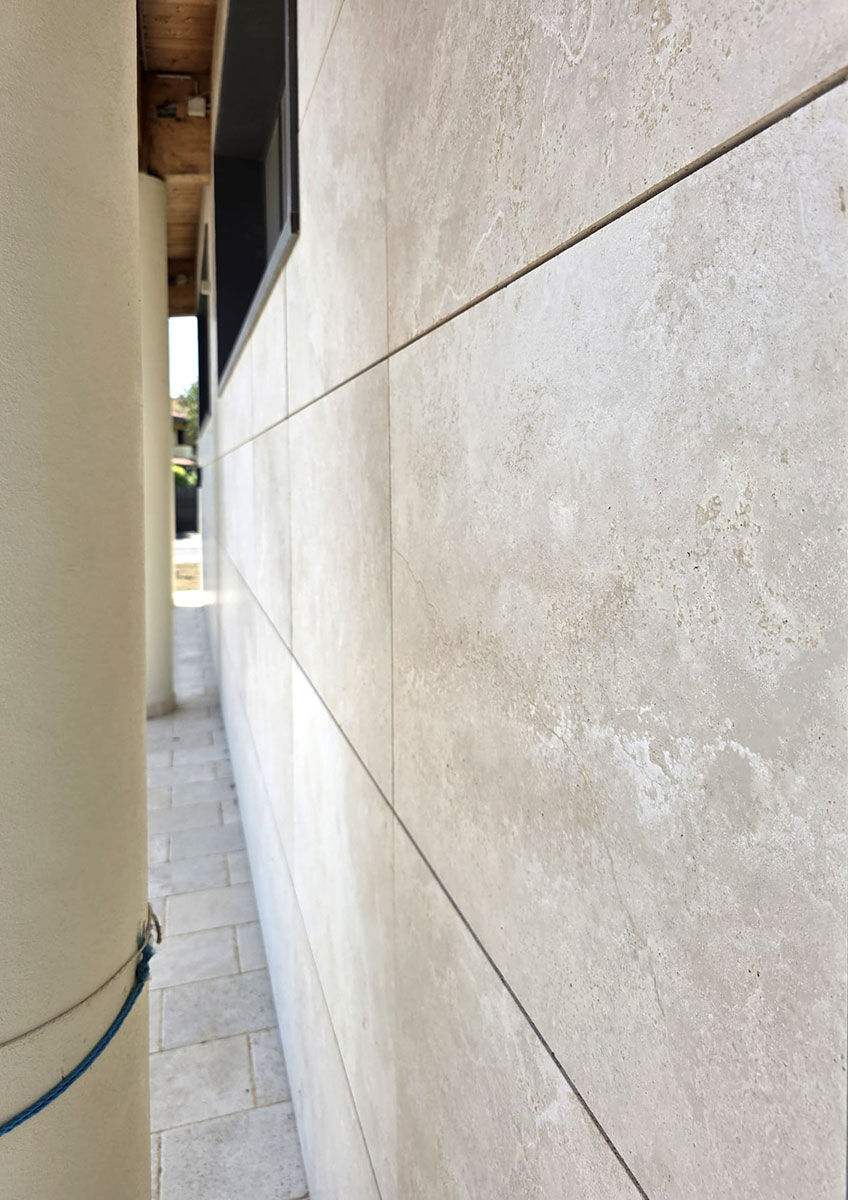
Our experience continues to live on in projects of exceptional historical and cultural value. Recently, we worked on the ventilated travertine facade at the Basilica of St. Paul Outside the Walls in Rome. Working in such contexts requires not only technology, but also a deep respect for stone materials and the ability to integrate modern systems into environments of inestimable value.
Today, we apply this same craftsmanship to the new frontiers of cladding: from the installation of natural stone to the technical bonding of large-format ceramics.
Why choose VM Group for “Special Projects”
There are installers and there are technology partners. VM Group belongs to the second category. Our history has taught us that every stone facade is unique and requires:
Dedicated structural analysis: We do not use standard solutions, but substructures designed for specific load requirements.
Multidisciplinary know-how: From solid stone to ultra-thin ceramic slabs with adhesive fixing.
Historical reliability: Experience that starts with the major public works of 2004 and extends to the architectural challenges of tomorrow.
When stone is essential and the project requires a higher level of detail, VM Group brings to bear the experience that has built the new monuments of our cities.à.



Comments