


Complete Guide to Ventilated Facades: Technology, Materials, and Energy Performance


Introduction: The Building Envelope of the Future
A ventilated facade is not just an aesthetic choice, but a multi-layered construction system that represents the most advanced solution for thermal and acoustic insulation in buildings.
With thirty years of experience in design and installation, VM Group analyzes in this guide the technical pillars that make this system the standard for sustainable, high-quality construction.
1. How does a ventilated facade work? The chimney effect

The heart of the system is the air gap between the insulation and the external cladding. Thanks to the temperature difference between the inside of the gap and the outside, a natural convective motion known as the “chimney effect” is generated.
In summer: Hot air rises and is expelled, drastically reducing the thermal load on the walls and cutting cooling costs.
In winter: The system keeps the walls dry, eliminating thermal bridges and the risk of interstitial condensation, preserving the structure of the building over time.
The secret to comfortable living lies in dynamic air management. During the summer months, solar radiation heats the external cladding; without the cavity, this heat would be transmitted by conduction to the masonry.
In a ventilated facade, however, the warm air in the cavity becomes lighter and rises, drawing in cool air from below. This continuous flow acts as a passive cooling system.
In winter, on the other hand, the cavity acts as a thermal shield that keeps the insulation dry, preserving its thermal resistance and protecting the structure from thermal shocks caused by frost.
2. Anatomy of the System: The 4 Fundamental Layers

For a ventilated facade to last 50 years, every component must be perfectly integrated:
Wall Support: The base of the building (reinforced concrete, brick, etc.).
Insulation Layer: Rock wool panels or eco-sustainable materials that guarantee thermal comfort.
The Heart of the System: The VM Group Substructure: This is where we make the difference. We directly manufacture aluminum alloy profiles designed to absorb structural loads and wind pressure, ensuring perfect flatness even at great heights.
External Cladding: The “face” of the building, which protects the internal layers and defines its aesthetics.
A multi-layer system is only effective if each component interacts correctly with the others.
The wall support must be checked to ensure that the anchors are secure; the insulation must be properly fixed to avoid thermal ‘gaps’.
However, the real difference is made by the quality of the substructure. A common mistake is to underestimate the importance of the metal alloy or the thickness of the profiles. Using non-certified materials can lead, within a few years, to galvanic corrosion or deformation that compromises the flatness of the facade, nullifying the aesthetic investment made in the cladding materials.
3. The Choice of Materials: From HPL to XL Ceramic

There is no such thing as the “best” material, but rather the most suitable material for the project.
Large Format Ceramic: Extreme resistance and zero maintenance. Ideal for urban contexts. (Link to Ceramic).
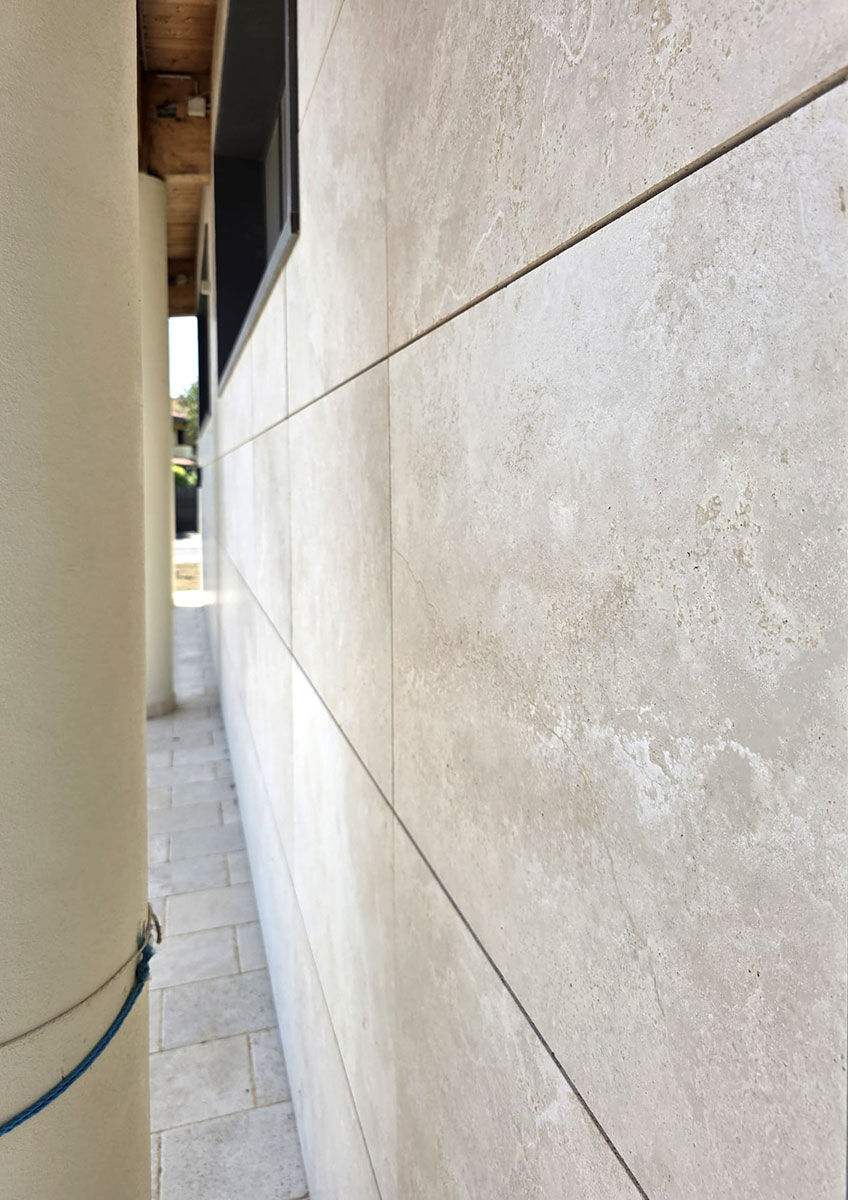
Natural Stone: The prestige of the classic combined with mechanical or adhesive fixing technology. (Link to Stone).
HPL and Fiber Cement: Lightweight and versatile colors for contemporary architecture.
Flexbrick Innovation: Ceramic fabric that allows you to create dynamic blinds and curved surfaces.
Each material has a specific expansion coefficient. For example, porcelain stoneware has minimal dimensional variations, while HPL panels or metal sheets require wider expansion joints and fastening systems that accommodate their movement.
This is where our technical advice comes in: we analyze the building's sun exposure and climate zone to recommend the material that guarantees the best balance between aesthetics and structural stability over time.
We don't just sell a panel, but a complete system certified for that specific material.
4. Fastening Systems: Mechanical vs. Chemical

Here we go into the technical details we discussed:
Visible Mechanical Fastening: Reliable and fast, with colored clips that blend into the joint.
Concealed Fastening (Kerf/Undercut): For total visual cleanliness, where the technique disappears into the material.
Glue Fixing (Modern Evolution): We discussed this in depth in our focus on [glue fixing], ideal for thin slabs and large formats where stress must be distributed evenly.
The choice of fastening defines the identity of the building. The exposed mechanical system is the most tried and tested, ideal for contexts where speed of installation is a priority. However, for designer projects, concealed fastening (using undercut holes on the back of the slab) or adhesive fastening (chemical system) are the preferred choices.
Chemical fastening, in particular, allows for unprecedented creative freedom, making it possible to use thin slabs without fear of mechanical breakage at the attachment points.
Each fastening system we offer is tested to withstand extreme wind loads, well beyond the legal minimum requirements.
5. Economic and Tax Benefits

Installing a ventilated facade is an investment that pays for itself thanks to:
Energy savings: Reduction of up to 30-40% in consumption.
Durability: Total protection of the structure from freeze-thaw cycles.
Property valuation: A building with a ventilated facade acquires a higher energy class and a higher market value.
In addition to immediate savings on utility bills, ventilated facades eliminate routine wall maintenance costs at the source. There will be no more cracks in the plaster, internal mold, or peeling paint.
From a tax perspective, renovating the building envelope with these systems often qualifies for energy efficiency incentives, allowing for a very quick return on investment.
A property renovated with a ventilated facade rises by at least two energy classes, increasing its commercial value on the real estate market by up to 15-20%.
Conclusion: The VM Group approach
Designing a ventilated facade means managing a complexity that only those who manufacture and install directly can master.
From initial technical consultation to the supply of the substructure and certified installation, our goal is to transform every project into a technological work of art.



Comments