


Concealed Fixing Engineering: Designing and Installing the KERF System in Stone Facades

Fluid Mechanics, Load Management, and State-of-the-Art Construction: VM Group's Approach to Large Stone Envelopes

The Skin Challenge Continues in Architecture
In the design of contemporary building envelopes, natural stone, such as travertine or thick stone materials, continues to represent the highest standard of prestige and elegance. In designing these envelopes, VM Group offers cutting-edge solutions for ventilated façades in natural stone, combining aesthetics and safety. However, combining the material's weight with a visually continuous, flat surface completely free of visible retaining elements is one of the most complex engineering challenges on a construction site.
The KERF mechanical fastening system was created precisely to meet this dual requirement: ensuring the utmost formal purity of the architecture while simultaneously ensuring the most stringent standards of static safety and resistance to dynamic stress.
1. The Invisible Mechanics of the Kerf System: How It Works
Unlike retention systems with exposed clips or hooks, Kerf technology works "inside" the material.
The principle is based on precise industrial processing: a continuous longitudinal slot or milling is performed on the upper and lower rib (the horizontal thickness) of each individual slab. Stainless steel anchoring plugs and brackets (A2 or A4) are inserted into this invisible groove, engineered using our facade anchoring and fastening systems, previously secured to the aluminum upright substructure.
In this way, the hook disappears completely from view within the thickness of the slab. The vertical load (self-weight) and horizontal load (wind pressure and suction) are mechanically and uniformly transferred from the stone to the building's metal framework, eliminating any risk of stress concentration at the edges.
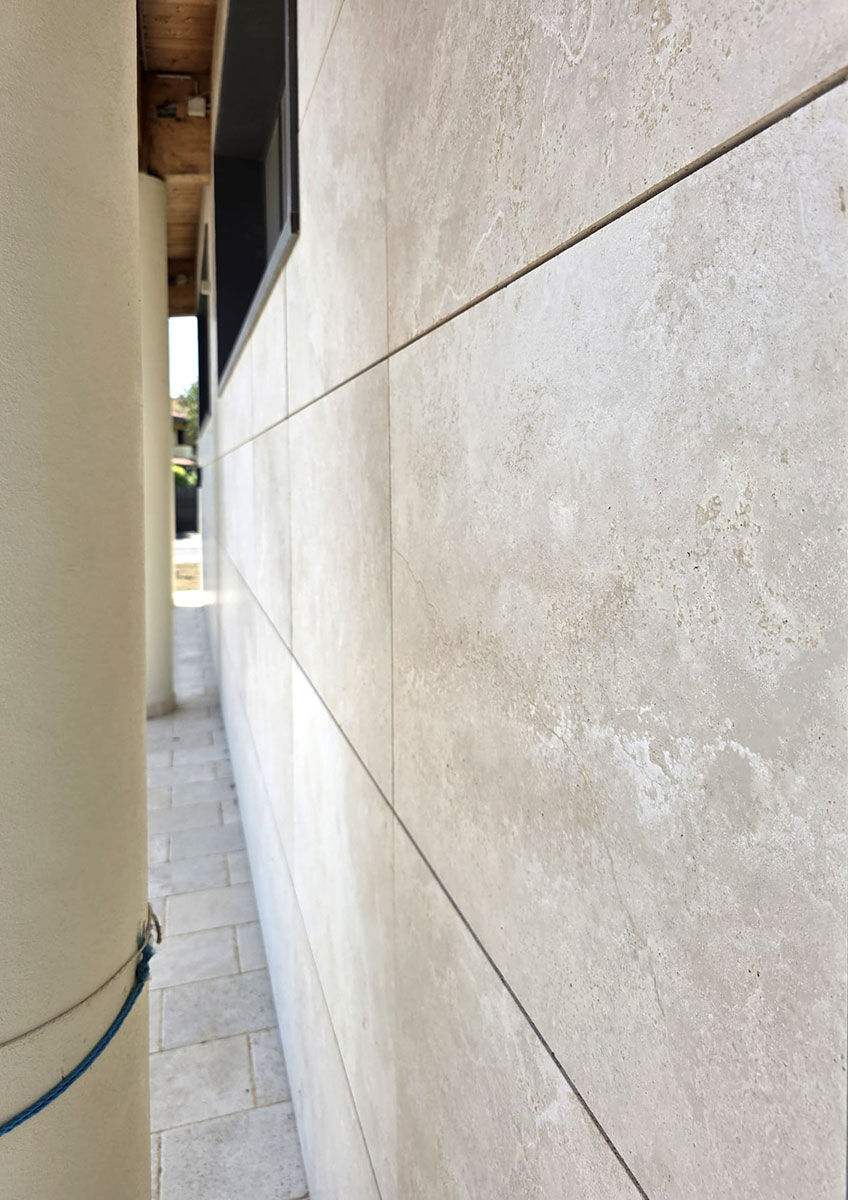
2. The Rule of Art in the Management of Cross Joints
When designing a Kerf façade, the purely aesthetic temptation is to minimize the space between the panels. From an engineering perspective, this is a serious structural error. Managing the joint and creating a perfect cross-joint are the true deciding factors in achieving good workmanship.
Within a ventilated facade, the panels must be separated by a constant, calibrated gap (never less than 4-8 mm). This space serves vital functions:
Pressure Equalization: Wind impacting the façade creates pressure differences. The calibrated joint allows air to penetrate the cavity in a controlled manner, equalizing dynamic pressure and preventing the "suction effect" that stresses the internal anchoring points.
Micro-Movements and Expansions: Metal substructures and stone slabs have completely different thermal expansion coefficients. The cross joint provides the millimeter-level space needed for the materials to move freely during seasonal temperature variations, preventing contact chipping or compression cracking.

3. Case Study: The Travertine Envelope of the A&O Shopping Center in Capalbio Scalo
To understand the effectiveness of the Kerf system on large volumes exposed to heavy traffic and constant weather, the ideal practical application is the recent project completed by VM Group for the A&O Shopping Center in Capalbio Scalo (Grosseto).
Managing the envelope of a public or commercial building of this size requires specific expertise in load calculations and field validation of masonry through pull-out tests and structural testing directly on site.
In this project, the use of natural travertine slabs with Kerf fastenings transformed a commercial structure into an architectural feature perfectly integrated into the landscape of the Tuscan Maremma.
Management of Critical Points and Construction Nodes
On large, geometrically complex surfaces like those of a supermarket, the challenge shifts to managing corner nodes and intradoses. The substructure and kerf system were calculated to maintain perfect alignment even at slope changes and window and door gaps.


4. Energy Optimization and Chimney Effect
Engineering a Kerf façade involves more than just carefully fixing the stone, but also ensuring the perfect functionality of the ventilation chamber behind it.
Keeping the air cavity free from obstructions and construction debris activates a natural chimney effect: the air in the cavity is heated by radiation, becomes lighter, and rises, exiting the upper overlap of the building and drawing in fresh air from below. This continuous flow extracts summer heat before it spreads inside the commercial spaces, drastically reducing air conditioning costs and ensuring maximum energy efficiency for the building.


Conclusions: VM Group Engineering Beyond Aesthetics
The Kerf system represents the perfect synthesis of engineering rigor and aesthetic purity. However, its complex execution leaves no room for improvisation: the installation tolerance for these systems is less than 2 mm, and each individual milling step must be calculated based on the density and stratigraphy of the chosen stone.
Thanks to our thirty years of experience in installing ventilated facades and complex building envelopes, and the rigorous application of certified internal technical specifications, VM Group S.r.l. is able to engineer customized solutions, as demonstrated by our large-scale natural stone ventilated facade projects for public, hospitality, and commercial projects.
Kerf System Reference Technical Data Sheet
Technical Parameter | VM Group Standard Specification |
Anchoring Type | Concealed mechanism inserted into the rib of the slab |
Bracket Material | Stainless steel AISI 304 / 316 (A2 / A4) |
Minimum Slab Thickness | Typically ≥ 20 - 30 mm (depending on stone material) |
Joint Width (Groove) | From 4 to 8 mm (calculated based on temperature variations) |
Primary Features | Pressure equalization, dynamic ventilation, minimalist aesthetics |


Comments